
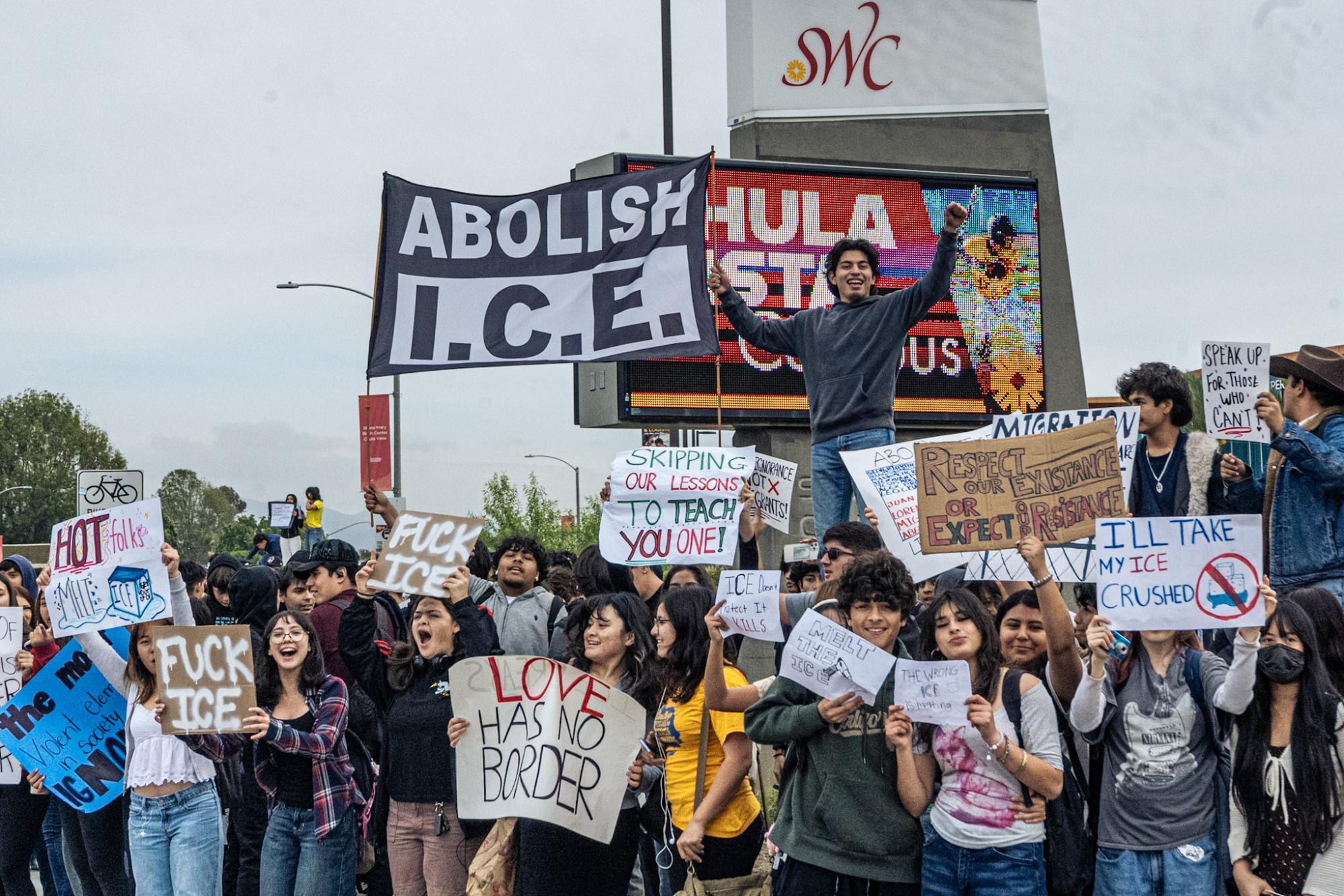

Eight minutes before lunch ended on Feb. 10, students at Bonita Vista High School began gathering near the soccer field by the campus exit. Staff members attempted to redirect students back to class, but chants from the growing crowd quickly drowned out those efforts. By the end of lunch, it was clear that the protest students had spent days organizing was underway.
For senior Shabaz Rodriguez, the walkout reflected concerns he shared with many students at BVH, particularly given the school’s location in a border community. Rodriguez said the issue of immigration enforcement felt personal to a large portion of the student body.
“San Diego is a border community. A lot of us have undocumented family members, know undocumented people or know people with undocumented family members,” Rodriguez said. “Naturally, students at our high school were incredibly concerned with the treatment of undocumented people within this country, and we decided that the best way to move forward was to step up, protest and speak up for these people, because the truth is, they cannot speak up for themselves.”
The walkout was planned days in advance. Students first met on Sunday, Feb. 1, at Kumeyaay park to discuss logistics, then continued organizing through an Instagram group chat of more than 100 students. According to Rodriguez, the size of the group made coordination difficult at first.
“There was a group of students who–to be entirely honest, I am not familiar with specifically–created a group chat of about 100-plus students,” Rodriguez said. “Eventually, a student noticed there was a lot of disorganization and called an in-person meeting. At that meeting, it was decided to set up a temporary structure where students could work with one another on different goals, like making signs, public relations and getting people out for the walkout.”
As organizing continued, the Sweetwater Union High School District addressed student demonstrations taking place across several campuses. On Feb. 4, Superintendent Moisés G. Aguirre sent an email praising student civic engagement while announcing that students would no longer be allowed to leave campus during the instructional day for off-campus protests due to safety concerns. The email stated that students who left campus without prior approval would be considered truant.
Rodriguez said the email initially caused uncertainty among organizers.
“Initially, there was panic,” Rodriguez said. “But after clarification from an independent lawyer, an anonymous district staff member and our legal observer, we realized the school could not punish students. We were emboldened by it.”
On the day of the walkout, multiple announcements were made over the intercom instructing students to go to class after the lunch bell rang. Instead, students moved through the halls from the grass field toward the cafeteria exit. By the start of sixth period, staff members were stationed at all campus exits while campus aides worked to usher students back to class.
Sophomore Mariajose Navarette described the moment students decided how to leave campus.
“[On] the day of, we all agreed to meet by the soccer field at [around] 1:25, and we did,” Navarette said. “For a good second, we were just stuck there, not knowing what to do before [Rodriguez] told us to go through the cafeteria doors. So, we left through that [exit].”
While many students were redirected back to class, others managed to exit campus either before doors were closed or because they were excused by a parent or guardian. Ten minutes into sixth period, the halls had largely cleared. Across the street, however, students who made it off campus gathered in front of Southwestern College. As the crowd gathered, the message behind the walkout came into sharper focus. What seems on the surface like a mere disruption of the school day was, for organizers, a calculated demand for institutional accountability—a demand shaped by fear, proximity and lived experience in a border community.
“The first demand is that the school release a public statement reaffirming its commitment to not allowing ICE officers on campus without a judicial warrant, as per California law. The second demand is a statement that warns the community about the dangers of continued ICE encroachment,” Rodriguez said. “Because we are a border community, many of us have undocumented family members or know recent immigrants. Even documented people are not safe, as there have been dozens of cases of U.S. citizens being deported simply for being Black or brown.”
At the protest students waved flags, held signs and chanted against ICE. Some climbed traffic lights and electrical boxes while others led chants through a megaphone. Cars passing by honked, drawing both cheers and louder chants from the crowd. Navarette said protesting off campus was a deliberate choice.
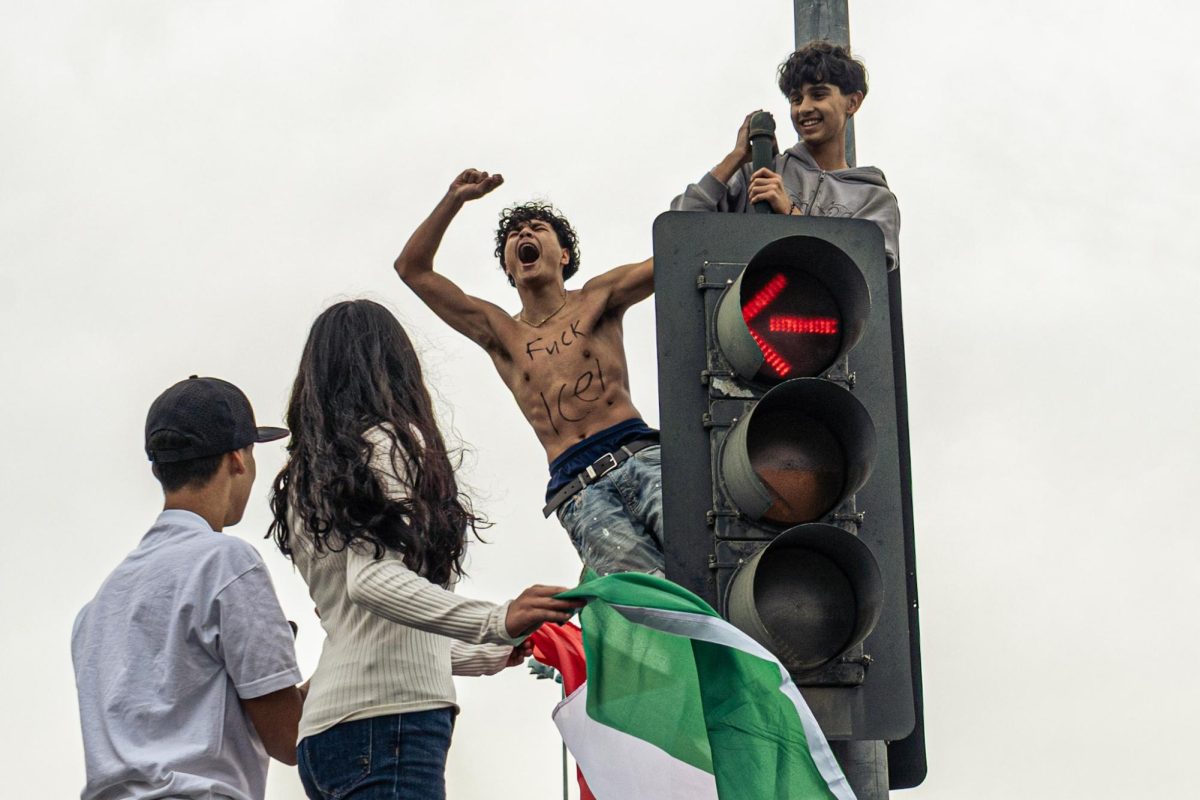
“Inside does not send such a significant message,” Navarette said. “It is like saying, ‘We care, but we are going to follow the rules.’ The walkout was one of the [most] meaningful parts of making sure our demands got met and that we made an impact.”
At the intersection, legal observers from the National Lawyers Guild Legal Observer Program in San Diego County were stationed on different corners. Director Kylee Belanger said observers were present at the request of organizers.
“We were requested by the organizers,” Belanger said. “We observe law enforcement behavior and use of force.”
Three Chula Vista Police Department officers observed the protest from the BVH parking lot across the street but did not interact with students. During the protest, senior Vincent Gonzalez brought cases of water from a nearby grocery store to help students stay hydrated.
Several students described the turnout as evidence that the issue resonated across campus. Juniors Aryk Winters and Jolie Liken-Lopez both said the number of students who participated stood out.
“With how many people that actually showed up,” Winters said, “I think it [was] probably more successful than a lot of other schools.”
By approximately 3:40 p.m., as the BVH school day ended, the protest began to disperse. Later that afternoon, Dr. Salazar sent a follow-up message to the school community via Jupiter addressing the core demands organizers had outlined. The message reaffirmed the school’s compliance with California law, including protections for students regardless of immigration status. For Rodriguez, the walkout was a measure of what collective action can look like within a school community.
“This shows what students can do when they come together,” Rodriguez said. “The real credit goes to the students who came together to fight for oppressed people.”


Alexa Vazquez • Feb 22, 2026 at 2:49 pm
These photos are phenomenal, begging y’all to submit these to an SPJ student contest
Leo Nguyen • Feb 17, 2026 at 2:55 pm
I was at the protest, and all the information is true and well represented in this article. Good article Amanda!
Elizabeth Hoffman • Feb 17, 2026 at 7:59 am
Such well-done coverage! You’re essentially modern Joan Didion at this point Amanda
Amanda Cortes • Feb 17, 2026 at 8:04 am
Wow, this makes me happy to hear. Thank you, my dear Elizabeth.